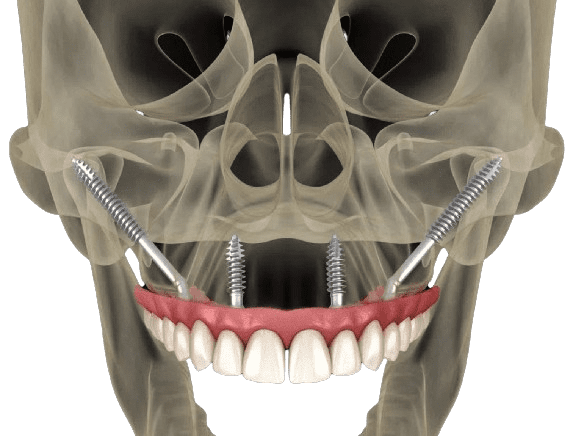
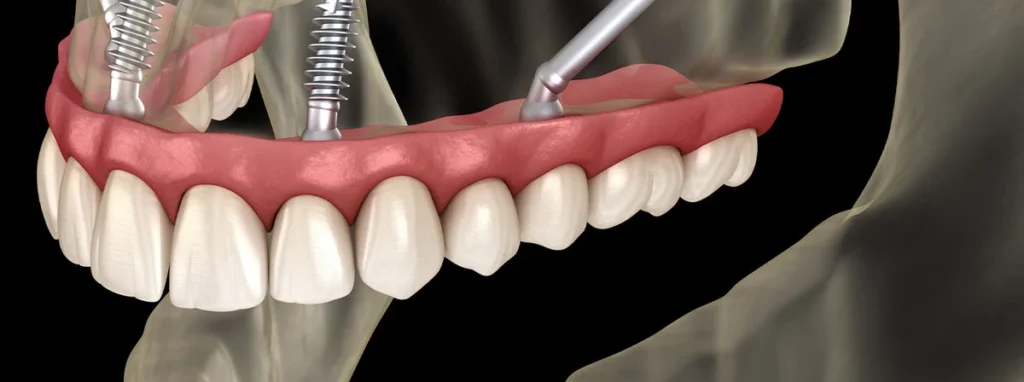
Zygomatic implants are a specialized kind of dental implant for one specific problem: an upper jaw that no longer has enough bone to hold conventional implants. Instead of anchoring in the jawbone, a zygomatic implant is longer and anchors in the zygomatic bone — the dense bone of the cheek — which gives fixed upper teeth a foundation even when the jaw itself cannot.
At State Of The Art Smiles in Pickerington, just outside Columbus, Dr. Phillip Katz evaluates and places zygomatic implants in the office, and the fixed teeth they support are designed and made in our own in-house lab. This is advanced, carefully planned surgery, and it begins the way everything here begins: a free consultation with 3D scans, and an honest answer about whether it is right for you.
See How Zygomatic Implants Work
Zygomatic implants at a glance
- Doctor: Dr. Phillip Katz — the owner of the practice, and the doctor who treats you
- Practice: State Of The Art Smiles, a privately owned dental office, 156 W. Columbus Street, Pickerington, Ohio
- For: Severe upper-jaw bone loss — patients told they have no bone for conventional implants
- Experience: More than 10,000 dental implants placed since 2008; restoring full mouths since 2000
- Final teeth: A fixed bridge, designed and made in our in-house lab
- Sedation: IV sedation and oral sedation, provided on site — Dr. Katz is licensed for both
- Consultation: Free, with 3D scans and a written plan that includes the full cost before you decide anything
- Phone: (614) 837-4506
- Hours: Monday 8:00–5:00, Tuesday 6:00–2:00, Wednesday 9:00–6:00, Thursday 8:00–5:00, Friday 8:00–2:00
Why does the upper jaw lose bone?
When upper teeth are lost, the jawbone that held them is no longer doing a job, and over time it thins — sometimes a little, sometimes dramatically. The sinuses above the upper jaw can also expand into the space where bone used to be. After years or decades without teeth, or years in a denture, some patients are left with very little upper bone at all.
Conventional implants need bone to anchor in. When that bone is gone, patients are often told implants simply aren’t possible for them — or that the only path is major bone grafting first. For the right patient, zygomatic implants are another answer, because they anchor in the cheekbone rather than the jaw.
Who are zygomatic implants for?
- Patients told they don’t have enough bone for implants, or that they are not implant candidates at all
- Long-time denture wearers whose upper jaw has thinned after years or decades without teeth
- Patients whose bone grafts have failed, or whose conventional upper implants have failed
- Patients facing the loss of their remaining upper teeth who want fixed teeth, not a removable denture
A note of honesty belongs here: zygomatic implants are not a shortcut and they are not for everyone. They are one of the most complex procedures in implant dentistry, and whether they fit your mouth is a judgment that can only be made from your 3D scans and your health history. Sometimes conventional implants, grafting, or a different plan is the better answer — and if it is, Dr. Katz will tell you that plainly.
How does Dr. Katz evaluate a zygomatic case?
Step 1 — Free consultation and 3D scans. You talk with our team about your history — the teeth you’ve lost, the dentures you’ve worn, the answers you’ve been given elsewhere. We examine your mouth and take 3D scans, which show the jaw, the sinuses, and the cheekbone in detail.
Step 2 — An honest assessment, and your plan in writing. Dr. Katz explains what the scans show and what your real options are — zygomatic implants, conventional approaches, or a combination — including the option of doing nothing right now. You receive the full cost of your plan in writing before you decide anything.
Step 3 — Surgery day. If zygomatic implants are your plan, they are placed here in the office, with IV or oral sedation if you choose it. In many cases patients leave with a fixed set of temporary teeth attached to their new implants; Dr. Katz will tell you at your consultation exactly what to expect in your case.
Step 4 — Healing and your final teeth. Over the following months the implants integrate and grow strong. Then your final fixed bridge is designed and made in our in-house lab — in the same building, by the team that knows your case — and fitted.
Why experience matters this much here
Zygomatic treatment is complex surgery near delicate anatomy, and it is not a procedure to have done by someone who places implants occasionally. Dr. Katz has placed more than 10,000 dental implants since 2008 and has been restoring full mouths since 2000.
He is a Fellow of the International Congress of Oral Implantologists (ICOI), one of the highest international designations for skill in the surgery and restoration of dental implants, and he completed advanced training for the treatment of the medically complex patient — the careful health review matters in cases like these. He was personally trained by Dr. Jack Turbyfill, considered by many the best complete denture prosthodontist in the world, and his work rescuing denture patients is directly relevant to the people zygomatic implants serve.
Other dentists learn from him: he was hand-picked by Dr. Frank Spear himself as one of the original 100 Visiting Faculty Mentors at the Spear Institute for Advanced Dental Education in Scottsdale, Arizona, where he also serves as an instructor, lecturer, and mentor, and he served as a Visiting Instructor at the California Implant Institute in San Diego, California. He was named America’s Best Dentist in 2013, 2014, 2015, and 2026. And because this is a privately owned dental office — not a corporate chain — the doctor who plans your case is the doctor who performs it and sees you at every follow-up.
This office has served Pickerington since the early 1960s, and Dr. Katz has practiced here for more than 25 years. If your case also involves the lower arch or your remaining teeth, our All-on-4 and All-on-X page and our full-mouth rehabilitation page explain how those plans fit together.
What do zygomatic implants cost, and how do patients pay for it?
The honest answer is that the cost depends on your mouth: how many implants your case calls for, what your scans show, and the sedation you choose. Zygomatic treatment is highly individual, and any office that quotes it without examining you and taking 3D images is guessing. That is why we do not guess.
At your free consultation, you receive the full cost of your plan in writing, and if something unexpected turns up during treatment, we stop and talk with you before it costs you anything. Most of our implant patients use financing with low monthly payments, which spreads the cost into a monthly amount that fits a household budget. If you have dental insurance, we will verify your benefits and apply whatever it covers toward your plan.
Zygomatic implant questions, answered plainly
What exactly is a zygomatic implant?
It is a dental implant designed for the upper jaw when there isn’t enough jawbone for a conventional implant. It is longer than a standard implant and anchors in the zygomatic bone — the strong, dense bone of your cheek — instead of the thinned jaw. One or more zygomatic implants, sometimes combined with conventional implants, can support a full fixed bridge of upper teeth.
I was told I have no bone and implants aren’t possible. Should I still come in?
Yes — that is exactly the situation zygomatic implants exist for. “No bone” usually means no bone where conventional implants would go, and that answer may have been correct for the techniques that office offered. Whether zygomatic implants can work for you depends on your cheekbone, your sinuses, and your health, and the only way to know is a consultation with 3D scans — which is free here.
My bone graft failed, and so did an implant. Can anything still be done?
In many cases, yes. A failed graft or a failed conventional implant does not use up the cheekbone, which is the foundation zygomatic implants rely on. Dr. Katz will evaluate what happened, what your scans show now, and whether a zygomatic approach — or a different plan — makes sense. You will get an honest assessment either way.
Is zygomatic implant surgery more involved than regular implant surgery?
Yes, and you deserve to hear that plainly. It is advanced surgery that requires detailed 3D planning and an experienced surgical hand, which is why the evaluation matters so much.
Dr. Katz is licensed to provide IV sedation and oral sedation on site, and most sedated patients rest comfortably through the appointment and remember little of it afterward. Before you decide anything, he will walk you through exactly what your surgery and recovery would involve.
Will I be without teeth during treatment?
In many cases, no. Patients often leave the surgery appointment with a fixed set of temporary teeth attached to their new implants, so you can smile and speak while healing takes place, and those temporaries are later replaced by your final bridge. Some situations call for a different sequence, and if yours does, Dr. Katz will explain exactly what to expect before treatment starts — you will never be caught by surprise.
What does it cost to find out if I’m a candidate?
Nothing. The consultation and the 3D scans are free, and you will leave with your options explained in plain language and the full cost of your plan in writing. There is no charge for the evaluation and no pressure to decide on the spot — take the information home and think it over.
Start with a free consultation. Call (614) 837-4506 to schedule. You will get a full evaluation, 3D scans, honest answers about your options, and a clear, written plan — with no pressure either way. Our hours are Monday 8:00–5:00, Tuesday 6:00–2:00, Wednesday 9:00–6:00, Thursday 8:00–5:00, and Friday 8:00–2:00.
