Written by State Of The Art Smiles. Medically reviewed by Dr. Phillip Katz, DDS.
If you have sat in a dental office, hopeful, and heard the words “you don’t have enough bone for implants,” you know how final that sounds. Many people leave believing the door is closed for good — that dentures are the only future available to them.
Before you accept that, it is worth understanding what that sentence actually means. In many cases it describes a problem with one particular technique: the conventional implant. There are other approaches designed for exactly your situation, and one of them — the zygomatic implant — exists specifically for people who have run out of bone in the upper jaw.
Why the upper jaw loses bone
Your jawbone stays strong because your teeth use it. When teeth are lost, the bone underneath them is no longer loaded the way it was, and the body gradually resorbs it. The upper jaw is especially vulnerable. Its bone is naturally thinner than the lower jaw’s, and the sinuses — air spaces in the cheek area — tend to expand downward over time, taking room that bone used to occupy.
Wearing a denture does not stop this process. A denture rests on the gums, so it does not pass chewing forces into the bone the way roots or implants do, and its pressure on the ridge can speed the shrinkage. Someone who has worn an upper denture for many years often has very little bone height left under the sinus — which is exactly when the “not enough bone” conversation happens.
What “not a candidate” usually means
In most cases, it means you are not a candidate for conventional implants placed straight into the jawbone, at least not without building the bone back first. That is a real limitation, and it is honest for a dentist to say so.
But it is worth hearing the sentence precisely. It is an answer about one technique, in one office. Some practices do not offer the alternatives, so their answer sounds like the end of the subject. It may only be the end of what that office can do. Our page on dental implants explains the standard approach and its requirements — the rest of this post is about what exists beyond it.
What a zygomatic implant is
A zygomatic implant is a longer implant designed to anchor not in the shrunken jawbone, but in the zygomatic bone — the cheekbone. The cheekbone is dense and stays dense even when the jawbone has largely disappeared. The implant is placed at an angle, reaching from where your upper back teeth used to be up into that solid cheekbone.
Because the anchor point is strong bone that never went away, zygomatic implants can often support fixed upper teeth without first rebuilding the jaw with grafting. Dr. Katz places zygomatic implants here in our office, and our zygomatic implants page describes the procedure in more detail.
Who zygomatic implants may help
The people this option was designed for tend to share a history. They have worn an upper denture for a long time. They may have tried bone grafting that did not take, or had upper implants fail because the bone around them was too soft to hold them. Or they were told their only path was major grafting surgery followed by a long healing wait before implants could even be considered.
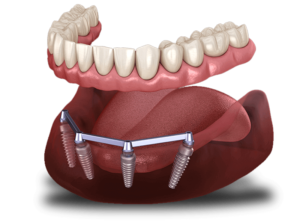
Zygomatic implants apply to the upper jaw only — the lower jaw has different anatomy and different solutions. And within the upper jaw, they are usually part of a full-arch plan, often combined with conventional implants toward the front, supporting a fixed bridge of teeth in the way described on our All-on-4 and All-on-X page.
The honest limits
This is complex surgery, and you should be wary of anyone who presents it as routine or right for everybody. Planning is done from 3D scans, because the exact path of each implant matters. Sometimes, after looking at the scans, grafting or a conventional plan is genuinely the better answer. Sometimes health factors mean implants of any kind are not advisable. No responsible doctor can tell you that you are a candidate — or promise you an outcome — before examining you and studying your imaging.
Experience also matters more here than in most dental procedures. Dr. Phillip Katz has been placing implants since 2008 and has placed more than 10,000 of them. He is a Fellow of the International Congress of Oral Implantologists (ICOI). That depth of experience is part of how cases like these are planned carefully rather than optimistically.
Find out what is actually possible in your mouth
Being told “no” once is not the same as there being no option. The only way to know is a proper evaluation.
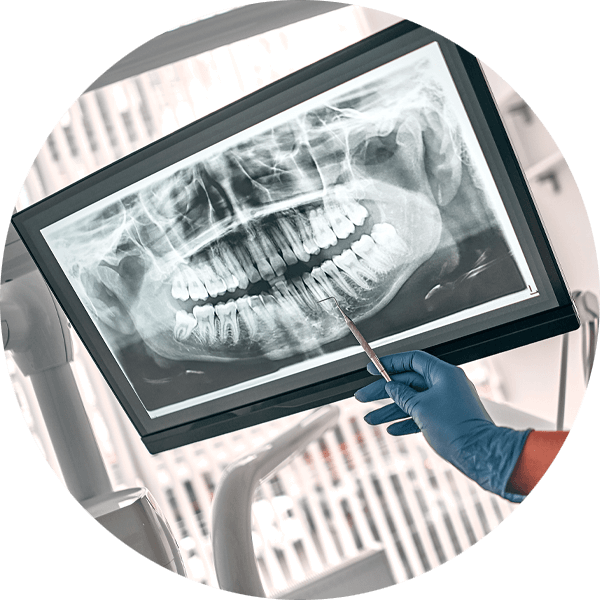
Your consultation at State Of The Art Smiles is free, and it includes a 3D cone beam CT scan and a full panoramic X-ray, so the conversation is based on your actual bone — not on a general rule. If a plan makes sense for you, you will see it in writing before you decide anything. Call us at (614) 837-4506 to schedule. We are in Pickerington, just outside Columbus, Ohio.